
I remember when the internet lived in a room.
You didn’t carry it with you in your pocket; it wasn’t glued to your hand as your primary form of social connection. It sat on a desk, and it had a screen that hummed a little too loud. Every time you sat down, you felt like you were going on a brand new excursion into the unknown. There were endless people to talk to: strangers who might as well have been from another planet. Entire worlds to stumble into with no instructions, or roadmaps, or “skip tutorial” buttons.
You just figured it out, learning how to make neopoints the hard way. Wandering around World of Warcraft with no real idea what you were doing, just hoping you didn’t get absolutely wrecked by something ten levels above you. You logged into Facebook when FarmVille was somehow the most interesting thing there, uploaded an entire album of photos from your weekend out with friends (titled something like “BESTIEZZZ XD”).
And yes, it was cringe, but it was real.
The only ads lived quietly on the sidebar where they couldn’t interrupt your every thought or infiltrate your friends’ posts. Quality-of-life updates simply didn’t exist yet, and UX wasn’t perfectly optimized because we didn’t even have a baseline to optimize in the first place. There was no out-of-control algorithm deciding what you should care about before you knew it existed.
You had to explore.
It meant something.
Now everything is optimized, and it all feels worse.
I think we’re all a little existentially fatigued by the internet. Every “authentic moment” sounds the same and looks suspiciously well-lit. We're told to post more, move faster, stay consistent, follow the trend—Oh, but be human about it! Cool. Great. Love that for us. We’re all stuck trying to keep up.
Like Syndrome said in The Incredibles, “when everyone’s super, no one will be.” In our case, if anyone can make content instantly, content stops meaning anything.
We removed the friction; there’s no barrier of entry requiring real effort. Comment sections are full of AI accusations, whether they’re accurate or not. Why would we pause and think “someone actually made this”? Because what if they didn’t?
It’s just too much. More videos. More hooks. More “STOP SCROLLING” from people who are clearly begging the algorithm for mercy.
Do you feel it too?
Engagement’s been weird, reach is inconsistent; everything is either underperforming or overproduced. We’re staring at an infinite supply, so nothing feels valuable at this point.
They stole our attention spans and lost our trust. Now, we’re taking it back in subtle ways: people are skipping videos entirely, pausing to take a breather in the endless feed and even full-on ignoring the trends they used to follow religiously. Instead, they’re gravitating toward things that feel… slower.
Which is how we end up here.
While everyone has been sprinting toward video like their life depends on it, carousels have just been sitting there outperforming everything else.
It makes sense, too, because platforms don’t really care about views anymore; they’re just coveting your time. Every swipe, every second spent reading, is a signal that you’re still paying attention. Carousels do that naturally, and that tiny bit of effort is enough to separate them from everything else.
All my social media managers can take a deep breath: video is still kickin’, but people are over the same repeat audio, stilted pacing, cut-and-paste formulas. You already know how the video ends before it even starts, or you just don’t care enough to see it through. Somebody on the screen is obviously reading from an AI-generated script while pretending they're not. Or worse, we're pausing to watch a video of bunnies hopping around on a trampoline... only to realize the entire thing was generated by AI.
Completion rates are dropping because we’ve seen these things already... a hundred times... in slightly different fonts... because they were all created in record time and uploaded raw from the same algorithm.
Meanwhile, carousels are annoying to make; they require you to sit down, take a bit of time, and think about your structure. That’s why they’re working. They’re just chill, like little mini books in your timeline that you can peruse at your leisure. Who would’ve thought people would actually want to start reading again?
We’re moving out of the “create as much as possible” phase and into the “I Am Not A Robot” phase. People want proof that your content is worth their time, and that value comes from the knowledge that:
Even the companies building this stuff are starting to pull back. You’re seeing “no phones” rooms, “human-only” events, spaces where the whole point is just, y’know, people talking to people again.
Brands are picking up on it too. Heineken recently leaned into this idea with a campaign basically saying: if you’re looking for connection, maybe step away from AI companionship and go have a beer with an actual human being instead.
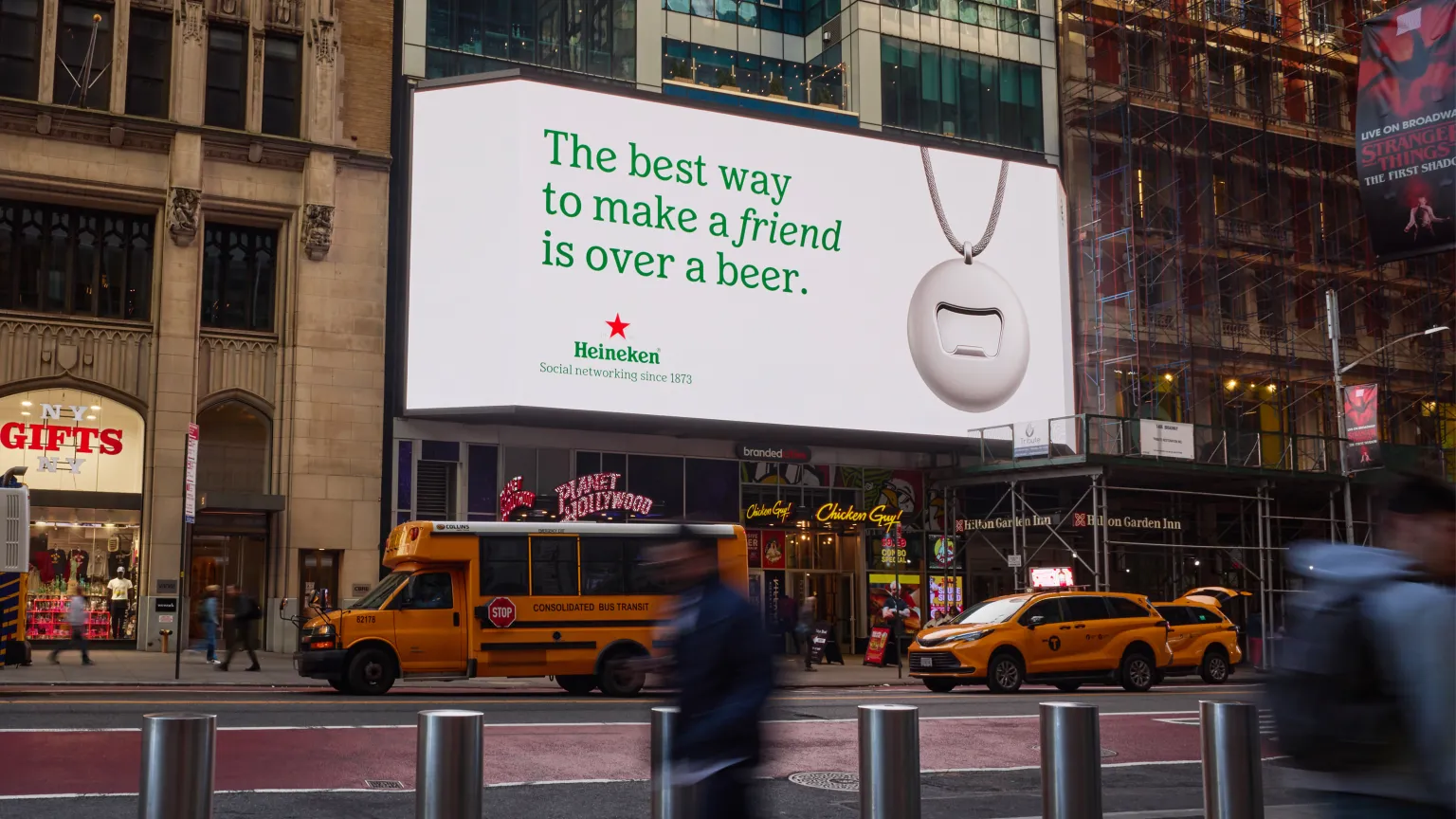
Which is interesting, because when the people building the machine—and the brands watching the culture shift—start nudging you back towards human interaction, it’s worth taking a closer look.
As always, this isn’t a fully anti-AI rant; it’s a useful tool, but tools aren’t the point. We all know that.
Unfiltered humanity is starting to feel rare, and therefore valuable. We’re starting to feel that shift in small ways and we, as humans, are slowing down in protest. We’re choosing to swipe through something that asks for our attention instead of something that demands it.
We’re realizing just how much of our time is monopolized on the daily: how much of it gets chipped away, minute by minute, by things that don’t really give anything back. And at the same time, the first digital native generation is aging; they’re noticing the time pass and taking note of how finite life actually is. Nobody is going to look back and say “wow, I remember all of that scrolling I did during my life.”
They’ll remember what held their attention, or made them pause, or made them feel something. They'll remember the connections they made. Moving forward, that’s the bar.
Not completely; unfortunately I can't throw my phone into the ocean and still maintain my job and social life. But we are seeing a shift back toward things you can actually hold and experience outside of a screen, things that don’t disappear the second you scroll past them.
Print definitely isn't dead and good packaging isn’t optional. Physical experiences are actually becoming the differentiator, because when everything digital starts to feel interchangeable, the real world starts to feel premium.
That’s where we’ve been leaning at DayCloud. We’ve always believed brands should exist in every dimension: packaging with the beholder in mind, printed materials that people actually want to keep, brand systems that translate just as well in someone’s hands as they do on a homepage
We build brands you can feel, beyond any algorithm.
The goal, at the end of the day, is to be remembered, and our memories and lifetimes are defined by our experiences as humans. In this era, that's becoming a luxury.